
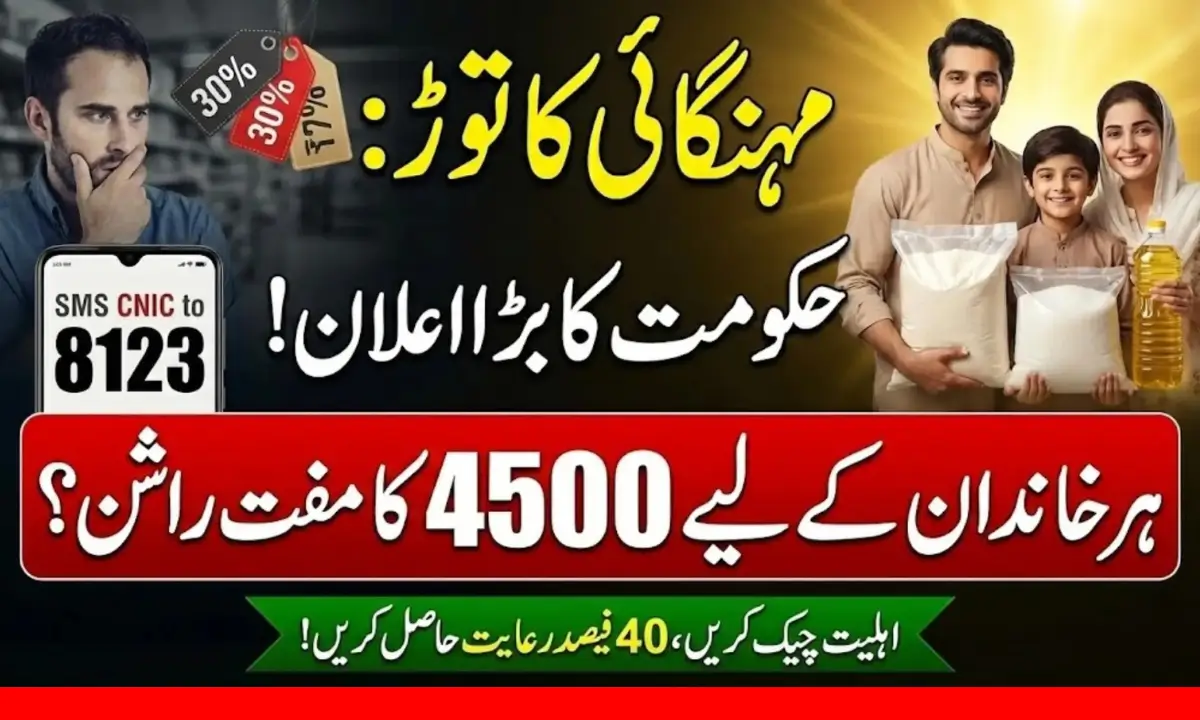
8123 Ehsaas Rashan Program
The Government of Pakistan continues to prioritize social welfare programs to support low-income and deserving families. One of the most significant initiatives in this framework is the Ehsaas Rashan Program, launched to provide essential food assistance to vulnerable households. This program is especially important in times of rising inflation, increasing food prices, and economic instability, as it helps families meet basic nutritional needs.
Also Read:Ehsaas Rashan Program CNIC Check Online 8123 – Complete Registration & Eligibility Guide
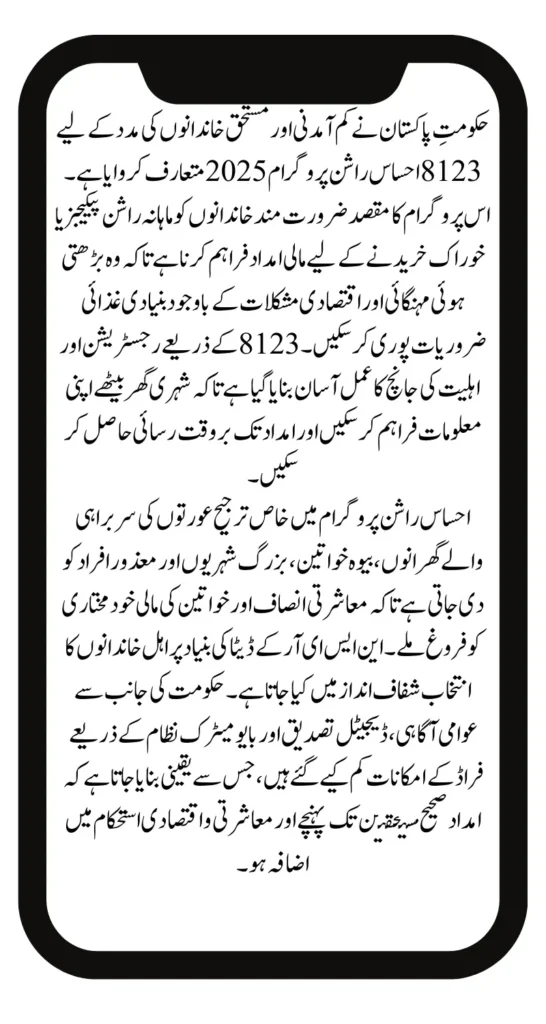
For 2025, the government has introduced the 8123 registration process, allowing eligible citizens to enroll in the program, check their eligibility, and receive updates regarding ration distribution. Through this system, families can access timely assistance without unnecessary delays, ensuring that aid reaches those who need it most. This article provides a detailed explanation of the 8123 Ehsaas Rashan Program, including its objectives, registration process, eligibility criteria, benefits, collection methods, common issues, and frequently asked questions.
What Is the Ehsaas Rashan Program?
The Ehsaas Rashan Program is a government-led initiative under the broader Ehsaas social protection framework. Its primary objective is to provide monthly food packages or financial support for purchasing essential food items to low-income families. The program is designed to alleviate the economic burden faced by vulnerable households, especially those affected by inflation, unemployment, or natural disasters.
The program is highly inclusive and aims to empower citizens by ensuring that no eligible family is left out. By providing direct access to food assistance, it reduces dependency on informal networks and charitable organizations, making aid distribution more transparent and accountable.
8123 Registration Process 2025 – Overview
In 2025, the government introduced a simplified registration process through the short code 8123, enabling citizens to register for the Ehsaas Rashan Program. This digital system allows families to check their eligibility using their CNIC (Computerized National Identity Card) without visiting government offices repeatedly.
The registration process is designed to be user-friendly, especially for individuals with limited digital literacy. It ensures quick verification, reduces paperwork, and minimizes delays in providing food assistance. Citizens can register for the program via SMS, call centers, or online through official government platforms, making the system widely accessible.
How to Register for the Ehsaas Rashan Program Using 8123
The 8123 registration process allows eligible citizens to enroll for food assistance quickly and conveniently. The steps include:
- Via SMS:
Citizens can send their CNIC number (without dashes) to 8123 from any mobile phone. Within a few minutes, they receive a confirmation message regarding their registration status and eligibility. - Via Call Center:
Citizens can call the official Ehsaas helpline and provide their CNIC information to register. Operators guide applicants through the process and provide details about the nearest distribution points. - Online Registration:
The government also allows registration through official Ehsaas portals. Citizens can fill out the online form, provide their CNIC details, and submit necessary information for verification. - In-Person Registration:
Families without access to mobile phones or the internet can visit designated Ehsaas centers to complete their registration. Staff members help collect the necessary information and guide beneficiaries on how to receive assistance.
Once registered, the system verifies eligibility using the National Socio-Economic Registry (NSER) and other government databases to ensure that aid is provided to deserving households.
Eligibility Criteria for the Ehsaas Rashan Program 2025
Eligibility for the Ehsaas Rashan Program is determined based on socio-economic conditions and poverty indicators. The key criteria include:
- Pakistani Citizenship:
Only Pakistani citizens with a valid CNIC can register for the program. - Income Level:
Households must fall below a certain income threshold to qualify. Families with higher income, government employees, or business owners are generally ineligible. - Vulnerable Groups:
Special priority is given to widows, single women, elderly households, persons with disabilities, and families headed by women. - NSER Database Verification:
Eligibility is cross-checked with the National Socio-Economic Registry to ensure transparency and prevent fraudulent claims.
These measures ensure that aid reaches the most deserving families and that resources are allocated efficiently.
Also Read:Cm Punjab Bike Scheme 2026 – Online Registration, Eligibility & Complete Details
Benefits of the Ehsaas Rashan Program
The program provides essential food assistance to low-income families in several ways:
- Monthly Food Packages:
Eligible families receive ration packages containing staple items such as flour, rice, sugar, cooking oil, pulses, and other essential commodities. - Financial Assistance for Food:
In some areas, beneficiaries receive cash or digital wallet transfers to purchase food directly from authorized markets. - Targeted Assistance:
The program prioritizes families in extreme poverty or with additional vulnerabilities, such as female-headed households. - Inflation Support:
By providing consistent food aid, the program helps families manage rising living costs, particularly during periods of high inflation.
How to Collect Ehsaas Rashan
Once registered and confirmed eligible, beneficiaries can collect their food assistance through several channels:
- Designated Distribution Centers:
Local distribution points are set up in communities, where beneficiaries can collect food packages directly. - Authorized Retailers:
Some areas allow registered families to receive assistance via selected shops or markets partnered with the government. - Digital Wallets or Bank Transfers:
In certain regions, the government provides cash equivalent through digital wallets or bank accounts for more flexibility in purchasing essential goods.
Beneficiaries are required to carry their CNIC during collection for verification. Biometric authentication may also be used to ensure secure delivery.
Common Issues Faced by Beneficiaries
Despite improvements in the registration and distribution system, some beneficiaries may encounter challenges:
- CNIC Not Found:
Some applicants may find their CNIC missing in the database due to outdated NSER data. Visiting an Ehsaas center or updating records at NADRA can resolve this issue. - SMS or Portal Delays:
During high-volume registration periods, responses from 8123 or online portals may be delayed. Persistence and contacting the helpline can help. - Distribution Center Issues:
In some remote areas, beneficiaries may face difficulties in collecting ration packages due to logistics or stock shortages. Local authorities usually resolve these delays promptly. - Verification Failures:
Biometric or manual verification may occasionally fail. Beneficiaries are advised to verify their CNIC details and update records as needed.
Role of NSER in the Ehsaas Rashan Program
The National Socio-Economic Registry (NSER) plays a crucial role in ensuring fairness and transparency in the program. It collects data about household income, family size, employment, education, and living conditions.
Using this data, the government calculates a poverty score to identify the most deserving households. Continuous updates to the NSER are essential to ensure that eligible families are not excluded and that resources are distributed equitably.
Government Efforts to Improve Transparency
In 2025, the government has taken several steps to enhance transparency and accountability in the Ehsaas Rashan Program:
- Digital Verification Systems:
Integration with government databases and biometric systems reduces fraud and ensures aid reaches the intended beneficiaries. - Public Awareness Campaigns:
Campaigns inform citizens about official registration channels and discourage reliance on unauthorized agents or middlemen. - Real-Time Monitoring:
Authorities closely monitor distribution and registration to quickly resolve complaints and address delays.
These measures make the program more efficient and trustworthy, ensuring maximum impact for vulnerable communities.
Impact of the Ehsaas Rashan Program
The Ehsaas Rashan Program has had a significant positive impact on society, particularly among low-income families:
- Reduced Food Insecurity:
Regular food assistance helps households meet daily nutritional needs. - Financial Relief:
Families save money for other essential expenses such as education, healthcare, and utilities. - Social Empowerment:
Prioritizing women and vulnerable groups promotes equality and empowers marginalized communities. - Economic Stability:
By providing targeted support, the program helps prevent extreme poverty and contributes to overall social and economic stability.
FAQs
1. What is the 8123 Ehsaas Rashan Program?
It is a government initiative to provide food assistance to low-income families through registration via the 8123 system.
2. Who is eligible for the program?
Pakistani citizens with a valid CNIC and low-income households, particularly vulnerable groups like widows, women-headed households, elderly, and disabled persons.
3. How can I register using 8123?
You can register by sending your CNIC to 8123 via SMS, calling the helpline, registering online, or visiting a designated Ehsaas center.
4. How often is food assistance provided?
Eligible families usually receive monthly food packages, or financial support depending on the area and program design.
5. What should I do if my CNIC is not found in the system?
Visit your nearest Ehsaas center or NADRA office to update your records and ensure your eligibility.
Also Read:Benazir Kafalat 13500 Payment Distribution Schedule – Complete Guide 2026
Conclusion
The 8123 Ehsaas Rashan Program 2025 represents a major step in supporting vulnerable communities in Pakistan. Through simplified registration, transparent eligibility criteria, and efficient distribution methods, the program ensures that food assistance reaches the households that need it most.
By prioritizing women-headed households and other vulnerable groups, the government is not only alleviating food insecurity but also promoting social empowerment and economic stability. Continuous monitoring, digital verification, and public awareness campaigns enhance the program’s effectiveness, ensuring that aid is delivered fairly and efficiently.
With proper implementation and active participation from eligible families, the Ehsaas Rashan Program is poised to continue playing a vital role in reducing poverty and supporting millions of Pakistanis across the country.