
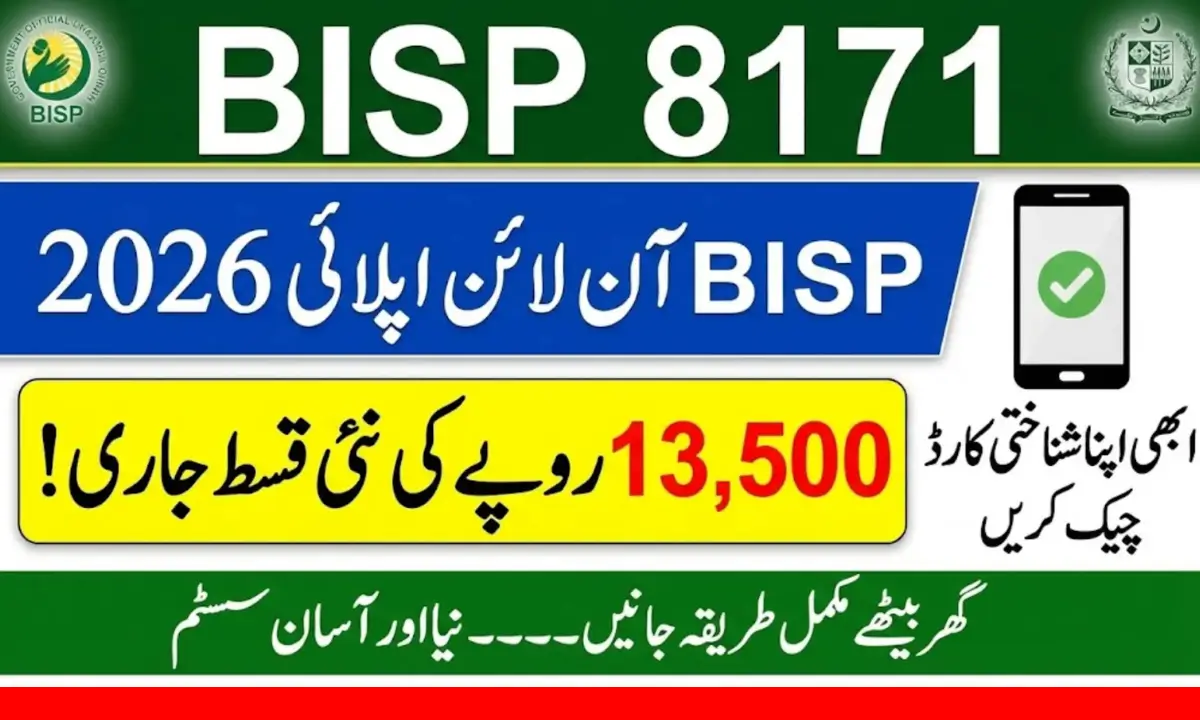
8171 New Update 2026
The Government of Pakistan continues to strengthen its social welfare system to support low-income and deserving families across the country. One of the most important initiatives under this system is the Benazir Income Support Programme (BISP), which provides financial assistance to millions of households. To make the process more transparent, accessible, and efficient, the government introduced the 8171 Web Portal, a digital platform that allows citizens to check eligibility, register, and track payments.
Also Read:Ehsaas Rashan Program CNIC Check Online 8123 – Complete Registration & Eligibility Guide
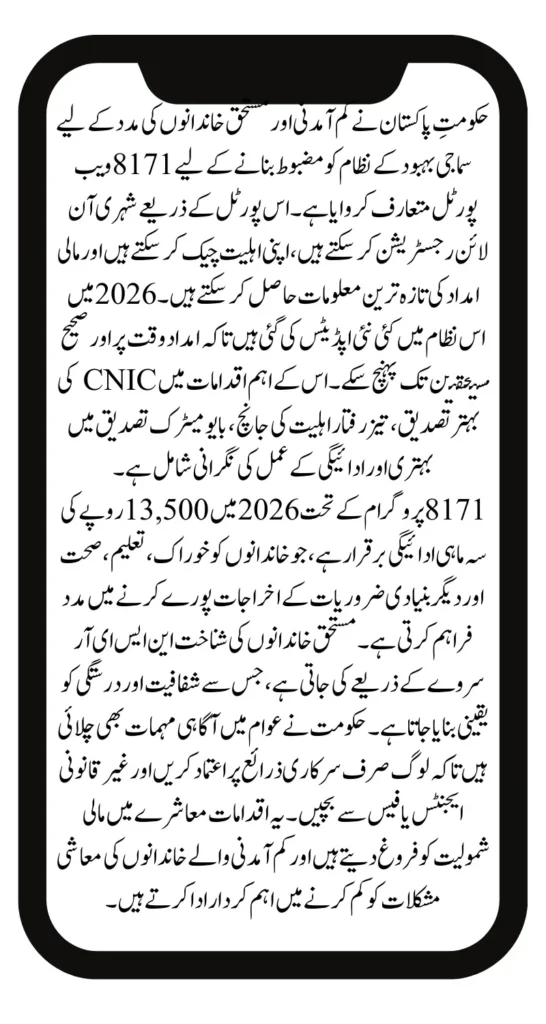
In 2026, several new updates have been introduced to the 8171 system to improve service delivery and ensure that financial aid reaches the right people on time. Among these updates, the continuation of the 13,500 rupees payment has drawn significant attention, as it provides critical financial relief to families struggling with rising inflation and living costs. This article explains the latest 8171 update for 2026 in detail, including registration procedures, eligibility criteria, payment details, status checking methods, common issues, and the overall impact of the program.
What Is the 8171 Program?
The 8171 program is part of Pakistan’s broader social protection framework, primarily linked with BISP and related initiatives such as Ehsaas. It serves as a centralized system through which beneficiaries can verify their eligibility for financial assistance using their CNIC number.
The program was designed to reduce dependency on physical offices and agents by providing a digital solution that ensures transparency and accountability. Through the 8171 Web Portal and SMS service, citizens can receive accurate information directly from official government sources.
Also Read:Cm Punjab Bike Scheme 2026 – Online Registration, Eligibility & Complete Details
8171 New Update 2026 – What Has Changed?
The 2026 update focuses on improving efficiency, expanding coverage, and minimizing delays in payments. The government has enhanced data verification systems and strengthened coordination between BISP, NADRA, and partner banks.
Key updates in 2026 include improved CNIC verification, faster eligibility responses on the portal, better biometric authentication at payment centers, and increased monitoring of payment distribution. These improvements aim to reduce errors, eliminate fraudulent claims, and ensure timely delivery of financial assistance.
The government has also emphasized updating NSER data to reflect current household conditions, making the system more accurate and fair.
13,500 Payment Details for 2026
The 13,500 rupees payment remains a core component of the 8171 program in 2026. This amount is usually provided on a quarterly basis to eligible families who meet the program’s criteria.
The payment is intended to help beneficiaries cover essential expenses such as food, healthcare, education, and utilities. Given the continued impact of inflation, this financial support plays a crucial role in preventing extreme poverty among vulnerable households.
Payments are released only after proper verification through the National Socio-Economic Registry (NSER), ensuring that assistance is provided to deserving families based on transparent criteria.
Also Read:Hurry Up! Register for the Punjab Green Tractor Scheme 2026 Before It’s Too Late
Eligibility Criteria for 8171 Payment 2026
Eligibility for the 13,500 rupees payment in 2026 is determined using NSER survey data. The government assesses household income, assets, employment status, and living conditions to calculate a poverty score.
Applicants must be Pakistani citizens with a valid Computerized National Identity Card (CNIC). Families with government employees, regular taxpayers, or owners of large businesses or properties are generally excluded from the program.
Priority is often given to households headed by women, particularly widows, divorced women, or women with dependent children. This policy aims to empower women and provide financial stability to families where women are the primary caretakers.
How to Register or Check Eligibility Through the 8171 Web Portal
The 8171 Web Portal allows users to check their eligibility status easily. To use the portal, applicants must enter their CNIC number without dashes and complete the captcha verification. Once submitted, the system displays whether the individual is eligible, under verification, or not eligible.
While the portal primarily supports eligibility checks, individuals who are not registered may be guided to visit their nearest BISP or NSER center to complete the registration process. Physical verification is still required in many cases to ensure data accuracy.
The portal is designed to be user-friendly so that people with basic digital knowledge can access it without difficulty.
Checking Payment Status via SMS
For individuals without internet access, the SMS service provides a simple alternative. By sending their CNIC number to 8171, applicants can receive information about their eligibility and payment status.
This service is free and accessible nationwide, making it especially useful for people living in rural or remote areas. The SMS response usually includes details about whether the payment has been approved, is under process, or has already been released.
Payment Collection Methods in 2026
Once approved, beneficiaries can collect their 13,500 rupees payment through authorized channels. The government has partnered with banks and payment service providers to ensure secure and efficient distribution.
Payments are typically collected from designated BISP payment centers, partner bank branches, ATMs, or biometric verification points. In selected areas, digital wallet options are also being introduced to further simplify the process.
Beneficiaries must carry their original CNIC for biometric verification. This step is mandatory to prevent fraud and ensure that funds are delivered to the correct person.
Common Issues Faced by Beneficiaries
Despite improvements, some beneficiaries may face challenges while using the 8171 system. One common issue is CNIC information not appearing in the database, often due to outdated or incomplete NSER data.
Biometric verification failures are another frequent problem, usually caused by fingerprint mismatches or technical issues. In such cases, beneficiaries are advised to visit NADRA offices to update their biometric records.
Payment delays can also occur, especially during high-volume distribution periods. If a payment is marked as released but not received, beneficiaries should contact the BISP helpline or visit a payment center for clarification.
Role of NSER Survey in 2026
The National Socio-Economic Registry survey remains the backbone of the 8171 system. It collects detailed information about households, including income sources, family size, education levels, and housing conditions.
Based on this data, the government calculates a poverty score that determines eligibility for financial assistance. Keeping NSER data updated is essential, as outdated information can lead to disqualification or delays.
Families whose circumstances change, such as income level or family size, are encouraged to update their information through official channels.
Government Efforts to Improve Transparency
In 2026, the government has taken additional steps to enhance transparency and accountability in the 8171 program. Digital verification systems, biometric authentication, and real-time monitoring have reduced the risk of fraud and misuse.
Public awareness campaigns are also conducted to educate beneficiaries about official procedures and discourage them from relying on agents or paying illegal fees. These measures help ensure that financial assistance reaches those who truly need it.
Impact of the 8171 Program on Society
The 8171 program has had a significant positive impact on low-income communities across Pakistan. By providing regular financial support, it helps families manage basic expenses and reduces economic stress.
The program also promotes financial inclusion by encouraging beneficiaries to interact with formal banking and digital payment systems. Over time, this can contribute to greater economic stability and social development.
FAQs
1. What is the 8171 program in Pakistan?
The 8171 program is a government welfare initiative linked with the Benazir Income Support Programme (BISP). It allows eligible low-income families to check their eligibility and receive financial assistance using their CNIC.
2. How much payment is given under the 8171 program in 2026?
In 2026, eligible beneficiaries receive a payment of 13,500 rupees, usually provided on a quarterly basis, depending on government schedules.
3. How can I check my eligibility for the 8171 payment?
You can check your eligibility by visiting the 8171 web portal and entering your CNIC number or by sending your CNIC via SMS to 8171.
4. Can I register for the 8171 program online?
The 8171 portal mainly allows eligibility checks. If you are not registered, you may need to visit the nearest BISP or NSER center to complete your registration.
5. What should I do if my biometric verification fails?
If biometric verification fails, you should visit your nearest NADRA office to update your fingerprints and then return to the payment center.
Also Read:Maryam Nawaz Announces Distribution Date for 50,000 Free Solar Panels in 2026
Conclusion
The 8171 New Update 2026 Pakistan reflects the government’s ongoing commitment to strengthening social welfare and supporting vulnerable populations. Through improved digital systems, transparent eligibility criteria, and timely payment distribution, the program continues to provide meaningful assistance to millions of families.
The 13,500 rupees payment remains a vital source of relief for low-income households facing economic challenges. While some issues persist, continuous system improvements and public awareness efforts are helping to address them. Beneficiaries are advised to keep their information updated, use only official channels, and regularly check the 8171 portal or SMS service for the latest updates. With effective implementation, the 8171 program will continue to play a key role in reducing poverty and promoting social protection in Pakistan.