
Class 8 Board Examinations in Punjab
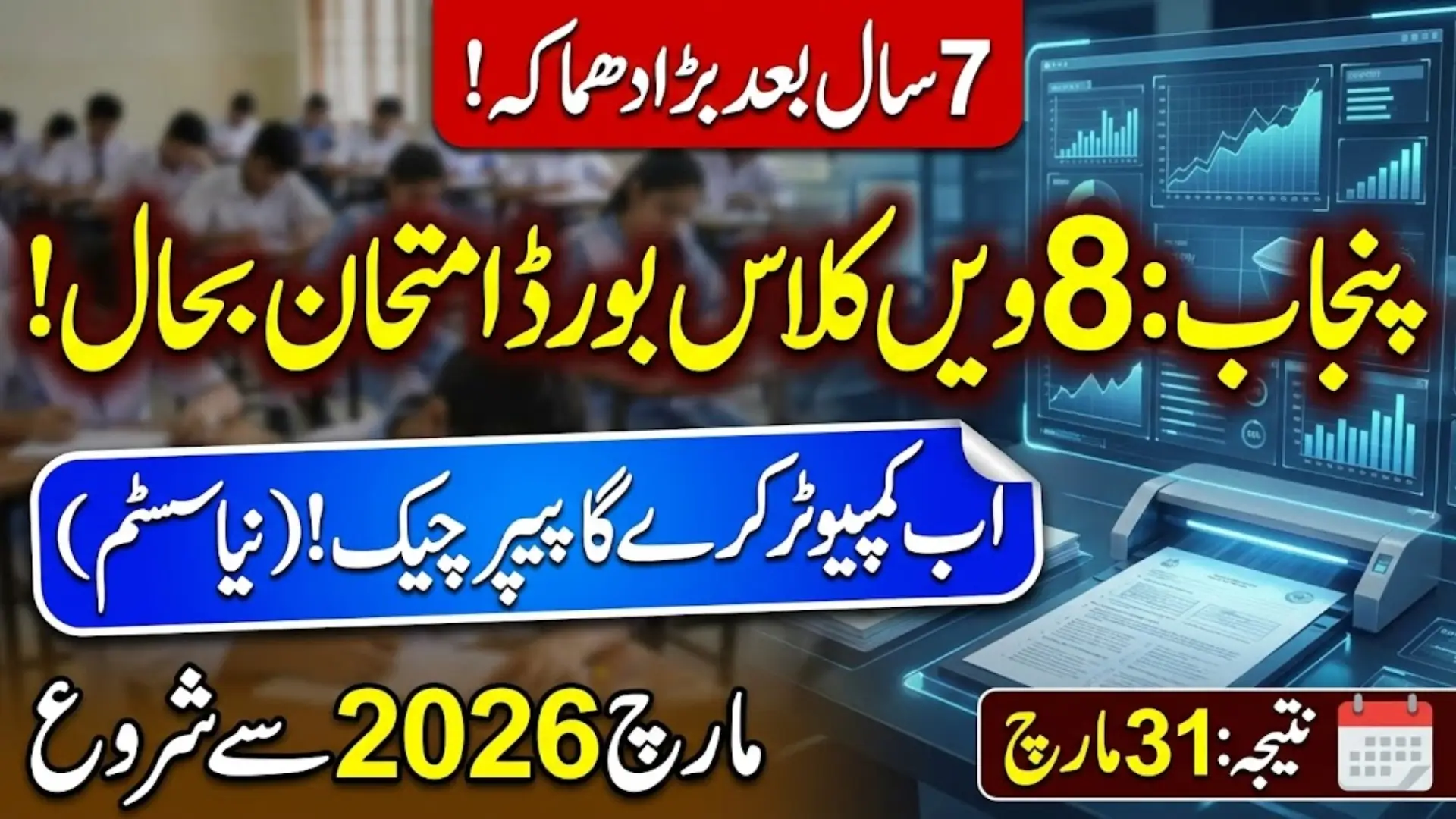
The Class 8 Board Examinations in Punjab will officially resume in the second week of March 2026 in government schools across the province. The exams will take place under the supervision of the Punjab Education, Curriculum, Training and Assessment Authority, which has been assigned the responsibility of organizing and managing the entire process. This revival marks an important step in strengthening the academic assessment system at the elementary level.
Maryam Nawaz Loan Scheme Online Apply 2026 Get Rs.
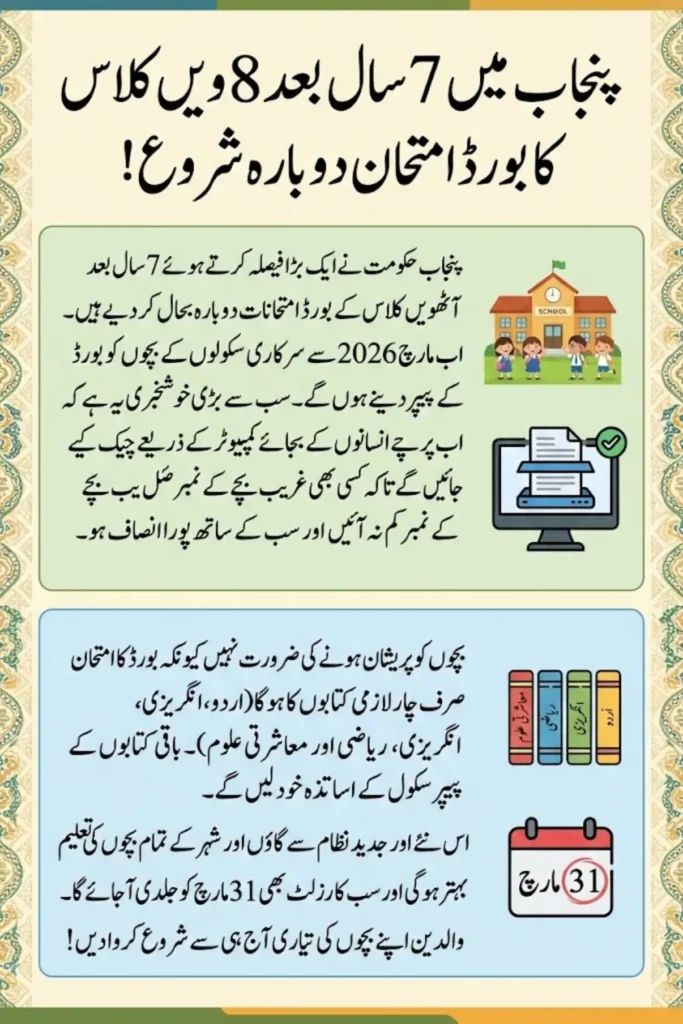
After a gap of several years, the Punjab government has decided to reintroduce a centralized examination structure for Grade 8 students. The move aims to standardize evaluation methods, improve academic performance monitoring, and ensure equal assessment standards across all government schools in Punjab.
- Exams starting in the second week of March 2026
- Conducted in government schools across Punjab
- Supervised by Punjab Education, Curriculum, Training and Assessment Authority
- Focus on standardized academic evaluation
Computerized Marking System for Class 8 Board Examinations in Punjab
For the first time, authorities will assess answer sheets using a computerized marking system. This modern evaluation method is designed to increase transparency, reduce human error, and speed up the result compilation process. Officials have confirmed that the results of the Class 8 Board Examinations in Punjab will be announced on March 31.
The introduction of digital marking reflects the government’s effort to modernize the examination framework. By adopting technology-based assessment, the authorities aim to ensure fair marking practices and maintain consistency in grading across all examination centers.
| Key Feature | Details |
|---|---|
| Assessment Method | Computerized Marking System |
| Result Announcement | March 31 |
| Transparency Level | High due to digital evaluation |
| Coverage | All government schools |
- First-time use of computerized marking
- Results scheduled for March 31
- Reduced chances of marking errors
- Faster processing of answer sheets
Exam Schedule and Subjects for Class 8 Board Examinations in Punjab
The Class 8 Board Examinations in Punjab will continue for two to three days. The examination schedule includes four main subjects: Urdu, English, Mathematics, and Social Studies. These core subjects have been selected to evaluate students’ understanding of essential academic areas at the elementary level.
While the board will conduct examinations for these four subjects, schools will internally manage exams for the remaining subjects. This approach allows institutions to maintain flexibility while ensuring standardized testing for major subjects under the provincial authority.
Ramzan Package Registration 2026 Complete Guide to
| Subject Name | Exam Type |
|---|---|
| Urdu | Board Examination |
| English | Board Examination |
| Mathematics | Board Examination |
| Social Studies | Board Examination |
| Other Subjects | School-Based Exams |
- Exams lasting two to three days
- Four core subjects included
- Remaining subjects handled internally
- Uniform testing standards across schools
Budget Allocation and Administrative Structure
The Punjab government has allocated Rs. 1.6 billion for conducting the Class 8 Board Examinations in Punjab. This financial allocation will support examination arrangements, staff management, logistical planning, and implementation of the computerized marking system. Proper funding ensures smooth operations and organized exam management across the province.
The authority has also issued standard operating procedures for examination staff. School heads will act as resident inspectors, senior teachers will serve as superintendents, and primary and elementary teachers will perform duties as test administrators. Staff selection for each examination center will be carried out through an online system to ensure transparency.
- Rs. 1.6 billion allocated for exams
- SOPs issued for examination staff
- Online system for staff selection
- Defined roles for inspectors and superintendents
Background and Revival of Class 8 Board Examinations in Punjab
Previously, Class 8 board exams were introduced through the Punjab Examination Commission. However, authorities discontinued the system after five years and later dissolved the commission. As a result, centralized examinations for Grade 8 were suspended for several years.
After a seven-year gap, the Punjab government has reinstated the Class 8 Board Examinations in Punjab under the new authority. This revival reflects the government’s intention to restore a uniform evaluation system and strengthen accountability in elementary education.
- Earlier system managed by Punjab Examination Commission
- Discontinued after five years
- Seven-year gap in centralized exams
- Exams reinstated under new authority
Good News: NSER Survey Registration Now Open for
FAQs
When will the Class 8 Board Examinations in Punjab begin?
The exams will start in the second week of March 2026. They will be conducted in government schools across Punjab.
Who will supervise the Class 8 Board Examinations in Punjab?
The Punjab Education, Curriculum, Training and Assessment Authority will supervise the examinations.
How will answer sheets be checked?
Authorities will use a computerized marking system for assessment. This ensures transparency and faster result processing.
How much budget has been allocated for the exams?
The Punjab government has allocated Rs. 1.6 billion. This funding will support examination arrangements and management.
Sindh Introduces Mandatory Tests for Deportees
Conclusion
The revival of the Class 8 Board Examinations in Punjab marks a significant development in the province’s education system. With computerized marking, structured supervision, and proper funding, the government aims to improve transparency and maintain consistent academic standards.
By reinstating centralized exams after a seven-year gap, Punjab is taking a strong step toward strengthening elementary education assessment. The new system is expected to enhance accountability, promote fairness, and ensure better academic monitoring across government schools.